Showing posts with label Tuesday movie reviews. Show all posts

Monday, March 2, 2015

Supernatural Movie Reviews: Constantine (2005)


Constantine

Year: 2005
Starring: Keanu Reeves, Rachel Weisz, Shia LaBeouf, Tilda Swinton, Peter Stormare
Directed By: Francis Lawrence (I Am Legend, the Hunger Games movies, a bunch of '90s music videos)

First of all, you've got to admit that's a pretty money tagline: Hell wants him. Heaven won't take him. Earth needs him. The movie doesn't really deliver on all that, but still...it's pretty cool. And despite its manifold problems, I can't help but sort of like this flick, which is kind of a no-brainer, considering that the director cut his teeth on nineties music videos and there's a scene where Keanu puts on "holy brass knuckles" and beats the crap out of a demon. That's my own issue, though.  Also: how can Windows XP's media player make me so nostalgic? I may have a real problem, guys...

Basic Plot
If you don't count the whole "making little sense" thing, this movie starts out with a real bang. An Average Joe in Mexico (average José?) happens upon the "Spear of Destiny" (more on this later), wrapped in a Nazi flag, immediately changing the course of this poor guy's life and causing him to be possessed(-ish) by the devil's son. We keep cutting back to him throughout the movie as he gets closer and closer to the center of action and we get the growing impression that this guy is invincible.

But we're also seeing how pesci our hero is. Keanu plays John Constantine, an exorcist-slash-whatever who lives in a weird steampunk fantasy loft (or is it a...boat? I admit to getting distracted during some of the slower parts), where giant chains, gears, and WWI-era cigarette lighters are standard equipment.

We see Constantine in action as he defeats demons here and there, but we also see that he's spiritually tortured and apparently blacklisted from heaven, even while death is drawing nearer in the form of cancer. (Aside: if you've always wanted to watch a sad Keanu cough up bloody phlegm, you're in for a real treat here.)


Fanboy Assessment
Okay, I usually try to keep this under wraps in my writing, but I happen to be a former comic book nerd, and the only reason it's "former" is because comics changed while I did not (at least not in ways having to do with my taste in entertainment). So I must comment on the fact that this movie is (sort of) an adaptation of a comic book.

The comic book character John Constantine was created by Alan M00re, who I believe to be one of the most overrated guys ever to enter the world of comics (especially when he's creating characters--Nite Owl????). (Also, I realize there are probably some people out there who will find this post through an "Alan M00re" Google Alert and then leave all my books one-star reviews; OOOH! Just got the idea to preemptively dodge that with the 0's.) In the mid-'80s, M00re created John Constantine while writing for Swamp Thing, basing his appearance and vibe on the singer Sting.

A few years later, John Constantine got his own comic book, which grew in popularity into the early nineties, sort of spearheading the "occult detective" genre and inspiring a bunch of other comics with a similar tone (along with Hellblazer, there was  Preacher, Hellboy, etc., not to mention the revival of some forgotten characters like the Spectre, Hellstorm, Ghost Rider, and Deadman), all helping to build up to a generation of brooding comic readers wearing black trench coats and watching The Crow before that became associated with killing your classmates

True John Constantine fanboys moan about the switch from brusk, blond and British to...well...Neo, but I think it works far better. (Maybe it's the "neutral mask" thing? I dunno.) Really, Neo is oddly suited to this sort of role. Not only the messianic Matrix stuff, but The Devil's Advocate and this movie. Heck, even going back to his Bill and Ted days, we find him traveling to heaven and hell, interacting with God and with Satan, who looked like this:


The cosmology of this flick is much more "Christianized" than the comic ever was, which I admit is the only reason I'd give a movie like this a second glance. The original John Constantine was far more rooted in the occult, and even when the comic started to evolve, Constantine didn't want Heaven or Hell to have a say in human affairs. In that way, he was the ultimate humanist. But this Constantine, after learning he is dying of lung cancer, makes a special trip to ask the Angel Gabriel for more time to get into God's good graces.

The storyline being "adapted" here (and I use that term very loosely) is the "Dangerous Habits" arc from 1991, written by Garth Ennis, who is not in the least underrated. Honestly, the character created by Moore (basically a 2D conman-sorcerer-slash-excuse-to-make-someone-look-like-Sting) isn't the same character from those issues. Ironically, Moore has famously refused to see any film adaptations involving his characters in recent decades, and, while this character is very different from Moore's creation (and is basically just standard Keanu), it's also better.


Merits and Demerits
What made this movie for me was the cinematography, which was super mid-nineties, in the best way possible, despite coming out in the mid-aughties. Shades of Se7en, Fight Club, and even Stigmata. Grimy diners and muted colors, lit with greenish florescent light. That POV shot on the cigarette falling, near the beginning, had me hooked. And that score!

The supporting cast is pretty solid too. Shia "Where the Beef?" plays Chas the wannabe demon hunter, in a super wide-eyed, earnest way that reminds us why America (sort of) fell in love with him to begin with. Rachael Weisz is doing that "Jennifer Tilly meets Marla Singer" accent that she did in Confidence and some other movies from that era and she brings plenty of life to her rather thin "tortured cop with a gift she doesn't want" character. She and Keanu have a great non-chemistry on-screen, which is just what the story calls for. Their first meeting is her walking toward an elevator, saying,  "Hold the door. You going down?" and Constantine, pressing the CLOSE DOOR button, answering, "Not if I can help it."

Other things I liked include the best product placement ever: after learning that he has terminal cancer, Constantine gazes up at one of those two-part billboards that reads, "Time is running out......to buy a new Chevy." (There's a nice little undercurrent of dark humor throughout.) I also dug the connection with going underwater to see the spirit world. And this is the first film to make something of how creepy cat's eyes look since....um... Cat's Eye.

But there was plenty to scoff at as well, ironically coming to the fore with the appearance of the incredible Osacr-winner Tilda Swinton, playing a rather androgynous Angel Gabriel (I know this sounds mean, but I seriously don't know if this was an artistic choice or just a side effect of casting Swinton). The White Witch plays Gabriel with black wings and the whole subplot (completely different from the comic book source materiel) is ripped off from an awesomely bad mid-nineties movie called The Prophecy. This Gabriel rebels against God (for the exact same reason as Walken's Gabriel in The Prophecy), is eventually damned to become human (yanked from The Prophecy II),  and the finding of extra biblical chapters (or "acts" as this movie calls them) is a pivotal plot element (as it was in The Prophecy). Aside: why the heck is Gabriel wearing a bunch of hospital bracelets?!


Other demerits:

  • Seriously, that "possessed person on the ceiling, in the corner" thing has been more over-done than any other gag in the history of supernatural movies. I remember being freaked out by it in 1990's The Exorcist III, but even then it seemed like a cheap move.
  • The "not-quite-there" CGI (video game quality by today's standards), particularly in the epically unfrightening "hell" scenes. To be fair, the CGI steps it up for the fight between Constantine and the snake-wasp-crab guy (credited with the corny name "Vermin Man").
  • Beeman, who is essentially Constantine's "Q" couldn't be trying any harder to be Simon Pegg. And he had "sacrificial lamb" written all over him. Yet the movie seemed to think it was pulling a big surprise with his death.
  • Some plot elements looked like they'd been improvised on the spot, like the priest (played by that beady-eyed heavy guy who's been consistently type-cast as a serial killer or cult leader for at least a decade) slamming himself in the hand with a corkscrew over and over. Wha--?
  • The Easter egg is the ultimate cheesy cliche. His sidekick has become an angel and flies up from his grave while Constantine looks on. Derp.


Theological Low Points
A reference to "The Book of Revelations" (plural) consistently confirms for me that a given book or film was written by someone with zero biblical training. And that's not surprising with this movie, in which the view of God can be summed up in the line, "God's a kid with an ant farm, lady. He's not planning anything."  Even though it is later acknowledged that maybe God did have a plan, God is conspicuously absent from this story. Why? Because God and the devil made a bet for the souls of all mankind, which entails no direct contact, just influence. The entirety of Christianity is based on the idea that this couldn't be more wrong. Christ made direct contact to the Nth degree.

From there it is, predictably, a spiritual gong show. Magic amulets, the symbols of alchemy which are tattooed on the protagonist (aside: if you're interested in alchemy--or if you're not--you should pre-buy my forthcoming book The Last Con!),  and various occult items, all of which are sources of spiritual bondage, are used to defeat the powers of darkness. A witch doctor is basically on the good side by default (recalling a spate of supernatural movies in the '80s, in which psychics teamed up with clerics to defeat the devil). Weisz's character says to Constantine, "I know the circles you travel in: the occult, demonology, exorcism..." Um... what?! On top of that, Constantine is constantly boasting and trash-talking demons during exorcisms, reminding them just who he is. In reality, such boastings have never really gone well.


So back to the "Spear of Destiny.". It's supposedly the spear used to pierce the side of Christ on the cross. When he brings it up, Angela answers, "I'm a Catholic, John. I know the crucifixion story." Wait, what? Then, by way of exposition, she adds, "Jesus didn't die by being nailed to a cross. He was killed by a soldier's spear." Wrong again. Jesus was already dead, which was confirmed by the spear piercing his side.
 
The Spear of Destiny is a whole thing in the DC Comics universe, involving Hitler and the crucifixion...and superheros of course. Even forgetting about Hitler for a minute, turning the blood of Christ into a trope in a monthly comic book or borderline-B-movie is a horrible thing to do…then again, I didn't complain about Indiana Jones and the Last Crusade. But even if it's fair game, the origin and attributes of this relic make no sense. The spear that pierced Christ somehow has great power for evil and destruction? How?? Satan's greatest failure and God's greatest victory are both seen in the cross...if this thing's going to have powers, why wouldn't they be exclusively good?

Another confused aspect of the movie is Constantine's own origin. He killed himself as a teen and spent two minutes in hell. Now, due to the suicide, he's doomed to go back there next time he dies. .. only that doesn't work, even if we assume the sort of "Catholic doctrine as rules in a D&D universe we created" worldview. The reason suicide is seen as such a deal-breaker in some traditions is because you automatically die with a mortal sin on your conscience. But, having come back, Keanu could just go to confession and be absolved of it.

This leads into one of the major theological near-misses: the idea of earning one's way into heaven. Gabriel chides, "You're still trying to buy your way into heaven...that's not the way this works." So far, so good. But in the end, it's Constantine's own self-sacrifice that saves him (not unlike the end of Frozen, only with worse CGI).

That's often the mark of these self-declared edgy spiritual thrillers: a mix of truth and error in a way that is somehow unflattering to both. Gabriel is sounding very angelic one moment and dropping an f-bomb the next.Constantine can't be forgiven his two minutes of self-induced death, but a demon can be sent to heaven against his well, simply by reading him his last rights (out of a NKJV Bible??) And of course, Satan gets to "decide who goes to heaven" by simply "letting them go."


Theological High Points
Predictably, there's not a ton here. The ulta-dapper demon in his fitted three piece suit, with his crisp British accent was certainly in keeping with the biblical notion that Satan's angels disguise themselves as messengers of light. And then, when he gets holy-brass-knuckled in the face (again, that was awesome), his true self can be seen beneath the veneer. "That's better," he quips, "au naturel." 

There's also the devil in a white suit (with black tarrish stains all over the cuffs of his pants). Peter Stormare plays Satan--a pretty obvious choice, since (apart from his wacky Russian cosmonaut in the notorious turd Armageddon) he has made a career of playing sickos, psychos, and baddies. This has its pros and cons. Again, someone less overtly evil would have further highlighted the "serpent" aspect of the devil...someone like Dakota Fanning or Dame Maggie Smith or Robert Prosky. Still, Stormare plays the part well (although not as well as Viggo Mortensen in The Prophecy.)

Along those lines, while it's a decent twist when Rachel Weiss (one of the most beautiful actresses working today) is suddenly a devil, why use makeup to make her look evil and gross (a la Stigmata or even Ghostbusters)? Even her teeth get yellow. How/why would that even happen?   It would have been far more fitting--and more off-putting--for her to stay gorgeous and be evil.

A few other high points:
  • The devil's son is named "Mammon." That is fitting. Although mammon's a lot more attractive in real life.
  • Throughout the movie, Constantine is annoyed by people who, instead of fighting evil, are dedicated to "keeping the balance" between good and evil. We may be guilty of that as well. And along those same lines...
  • Before going all Neo on a room full of demons, Constantine awesomely grits, "All of you...go to hell." If only we would so completely and relentlessly put to death our sin natures.


Best Scares
  • The moment of panic after the exorcism when the viewer has no idea what's wrong.
  • "Close your eyes and whatever happens . . . don't look."
  • The cattle dropping dead as the antagonist walks by.
  • The first big lunge toward the camera when Angela arrives in hell.  (Very fake, but still made me jump)

Worst Attempted Scares
  • All the Zack Morris cordless phones ringing at once.
  • A guy's half-a-face, lying on a table, talking. That's just...hilarious.


Memorable Quotes
  • "I've been seeing some unusual soul traffic."
  • "It's a rat in a dress.” “Of course it is."
  • "I thought I heard thunder last night. Must have been Satan's stomach growling."
  • "Two hundred dollar shirt, by the way."
  • "That's called 'pain.' Get used to it."

Saturday, May 18, 2013

In the Works...

What you'll see on this blog over the next few weeks:
  1. Two Book Reviews 
     

  2. A Book Giveaway 
     
  3. Return of the satisfyingly snarky Tuesday Supernatural Movie Reviews 
     
  4. Another Gut Check Press satirical white paper  
     
  5. Huge news about my forthcoming novel Demoniac 


Tuesday, January 22, 2013

Supernatural Movie Reviews: The Devil Wears Prada

So, this week's movie review was a little perplexing for me. There wasn't nearly as much supernatural content as the title would suggest. I expected spiritual warfare, possession, curses, etc...which is weird, since this was like my third time watching this movie.  Whatever; let's try and salvage this thing anyway, shall we?


The Devil Wears Prada

Year: 2006
Director:  David Frankel (Hope Springs, Marley & Me, Chainsaw Slaughterhouse XII)
Starring: Meryl Streep, Anne Hathaway, Stanley Tucci, Emily Blunt, The Mentalist

I submit that, despite its lack of CGI demons or Aramaic curses, this film gets closer to identifying the character of the devil than most of the others I’ve reviewed. Why? Because she’s easy on the eyes, soft-spoken, and very persuasive.  If only she came across as having your best interests, not hers, in mind, she’d be a perfect representation of the Old Serpent.

The devil in question is Miranda Priestly, the head of a major fashion magazine called Runway (which is totally not Vogue). I absentmindedly asked my wife if she thought Miranda Priestly was related to Jason Priestly, to which she replied, “Well, they do have the same haircut,” outing the elephant in the den: why on earth would a sixty-year old female fashionista have that early-’90s skaterboy hairstyle? I mean, I’m no fashion expert, but all that thing needs is some sideburns and a leather jacket with popped collar and she could be “shredding it” on her “deck” in no time... In fact, I think the natural next step here would be to shave around the sides and back, but leave the top intact. 

Anyway, this all just goes to prove that Meryl Streep is gorgeous no matter what Vanilla Ice-era phenomenon is thrown at her. Flank her with Stanley Tucci (who should be in every movie, ever) as the eventually-empathetic layout designer and Emily Blunt as the vicious former assistant to the Devil, who hates anyone less fashionable than herself and who would later reprise this role in 2011’s The Muppets (working for Miss Piggy, which is weird, as Blunt also played Ruthie “Pig Face” Draper in Dan In Real Life, which is probably a better movie than this one, despite Dane Cook’s attempts to make it into a Dane Cook movie). And you thought St. Paul wrote long sentences.


Now enter Andy Sachs, a plucky, young aspiring journalist whose last hope at working for a NY magazine is this job opening (that millions of girls would apparently kill for, but not really) as Miranda Priestly’s new assistant. Andy is played by Anne Hathaway, who cut her teeth in another plain-to-glamorous transformation movie as an awkward adolescent in some Disney princess-flick with an aged Mary Poppins (and who will someday be forced to answer for ruining Cat Woman for a generation).

Through a twist of plot-contrivance, Andy gets the job, struggles greatly for a time, and then slowly finds her sea legs, while (gasp!) becoming more like the people she works with! We know this is happening because she starts dressing more like a prostitute and because her trollish boyfriend, who is always cooking and/or moping, starts cooking less and moping more. That and she answers the phone a lot when her boss calls. Upon first laying eyes on Andy, Tucci’s character asks, “Who is that sad little person? Are we doing a before-and-after piece I don’t know about?”  Answer: yes.  Before and after the Devil gets her hooks into poor Andy.


The “Dragon Lady”
So what makes Miranda such an accurate Devil? It’s not that she is curt and demanding with her employees, but that she enjoys turning friends against each other and manipulating people into betrayal. Perhaps even more than that, it’s that she wants to turn everyone else into her miserable,
hard-hearted self.

And like the Devil, Miranda works slowly and methodically, not caring about instant change. She’ll happily spend years molding Andy into her own image, but in just a matter of months, we see her young assistant already conforming to Miranda’s wishes, even failing the fairly obvious, “Do I answer the Devil’s phone call or tend to the last hanging thread of my closest personal relationship?” test.

Andy, for her part, deals with all of this the way most of us deal with the relentless work of the Enemy in our lives: she justifies herself. A lot. She’s just trying to stick it out for a year, she tells herself. She just can’t let Miranda “get to her.” But when you dance with the Devil, the Devil don't change—the Devil changes you. Before long, her boyfriend has stopped moping long enough to whine that, “You used to make fun of the Runway girls. Now you’re one of them.”

As they are wont to do, Andy’s self-justifications grow quickly from, “Same Andy, better clothes” to throwing up three lame, half-hearted objections, followed by a defeated, “I’m out of excuses,” followed in turn by sleeping with the creepiest looking dude in the history of film, despite having a committed boyfriend.

At the heart of all this is, of course, the believing of lies. That’s the Devil’s whole gig. Mopey accurately calls it, when he declares, “Looks like somebody’s been drinking the Kool-Aid.” We, the viewers, see it when Anne Hatheway says, with a straight face, “I’m not skinny.” What?! Everybody’s skinny in this movie! Everyone! Even the perpetually-chubby Harry Crane from Mad Men is skinny here. But once we start letting ourselves believe little lies, it’s not long before we believe the big ones. In the world of Andy Sachs, deliverance comes in the form of quitting her job and getting back to who she originally wanted to be (i.e. a reporter for a NY newspaper that hasn’t existed in a century). When dealing with the lies of the actual devil, deliverance lies not in ourselves and our self-justification and self-affirmation, but in denying ourselves and being justified by Jesus Christ.


Best Scares
  • The first appearance of the creepy (and less than helpful) twins. Come play with us, Andy. Forever and ever...
  • The first glimpse of Miranda sans makeup. But, after a second, you again realize that Meryl Streep is always beautiful (except when she’s doing that Margaret Thatcher voice, which gives me all kinds of the willies). 

Memorable Quotes
  • “The person whose calls you always take—that’s the relationship you’re in.” BTW, Andy, for crying out loud: change your ringtone! Seriously, what person (under 70) leaves the annoying Nokia jingle that comes default on their phone? I can’t imagine they paid for product placement here, seeing as how the phone essentially destroys the protagonist’s life, relationships, and character.
  • “By all means move at a glacial pace. You know how that thrills me.”
  • “That's all.”


Tuesday, January 8, 2013

Supernatural Movie Reviews: Fallen

Both of the novels I've written (42 Months Dry and Demoniac) could be considered “supernatural thrillers,” meaning they are action/suspense stories involving miraculous elements, demons, pagan worship, possession and exorcism, etc. And since most of what the general populace knows about these things comes from Hollywood, I’ve decided that, each and every Tuesday, I will review one of these films, looking at everything from cinematography to theological accuracy. I'll be focusing on the mid to late-’90s and early aughties, when these were experiencing a revival, as well as perhaps taking in a couple of the most recent crop. 

Fallen


Year: 1998
Directed by: Gregory Hoblit (Primal Fear, NYPD Blue)
Written by: Nicholas Kazan

This movie has a rating of 6.9 stars on IMDb. Seriously?! 2007’s The Mist, which I consider to be one of the five worst films made in the last twenty years, has a 7.3. There’s no accounting for the horrible taste in movies of the general public.

From the outset, you have to realize that this is not a horror movie and barely even a thriller. It's an intense story with supernatural elements and a great twist ending, written by a guy who seems to have mainly written a bunch of junk before this (including the late '90s J-Lo vehicle, appropriately named Enough). He did pen a 1986 movie staring the amazing Christopher Walken and Sean Penn, but the fact that a Walkenophile like myself has not seen it leads me to conclude that it was unremarkable.

But that doesn't matter.  I mean, have you ever seen Identity? If not, see it post haste (if you like horror/suspense/thrillers). It was written by a man whose most noteworthy writing credit to date had been the “horror” B-Movie Jack Frost, which basically replaces Chucky with a snowman and has him murder a bunch of people. I guess you never know who has a brilliant story inside of him.

The Cast
This is one of the best all-star ensembles in a decade filled with all-star ensembles.

Let’s start with Denzel Washington, my yardstick of cool, who plays the main character, a Philadelphia detective assigned a series of grisly, baffling murders. In addition to being distractingly handsome, he looks so insanely young here, reminding me anew that my early twenties were fifteen years ago. The coolness he exudes is manifest in some great one-liners and a habit of flipping a coin through his fingers, a la Iceman in Top Gun.

The rest of the ensemble fires on all cylinders as well. John Goodman plays Denzel’s partner/sidekick, the loveable wisecracking cop, who somehow does not seem like a tired cliche, despite being a loveable wisecracking cop sidekick. Seriously, name a movie starring John Goodman that wasn’t improved three-fold by his very presence. Donald Sutherland also nails his roll as the police captain who loves the status quo and doesn’t want to deal with the possible supernatural elements at play. Add James Gandolfini (for once not ending anyone’s career by appearing in a movie) as the cynical, semi-dirty cop and Embeth Davidtz, who I only recognize from a bit-part on Scrubs, and who looks like the female version of Johnny Depp. (I mean that as neither a compliment nor an insult.)

Then you’ve got the serial killer, played by Elias Koteas, who has turned in great performances in everything from Apt Pupil to Benjamin Button to The Prophecy (which I will soon be reviewing), but who is always first and foremost Casey Jones to me. But he’s creepy enough here and seems to do a decent job on the Aramaic lines.


"Cowabunga, dude! I'm a demon-
possessed serial killer!" [translated

from the Syrian-Aramaic]

Merits and Demerits
It starts with a black screen and Denzel saying, “I want to tell you about the time I almost died.” The narration throughout just works. It’s done, not as a horror movie, but as a straight-forward detective story (complete with smooth sax riffs over rainy establishing shots and research montages). The editing is likewise smooth and the picture, unlike a lot of late-'90s fare, really showcased my HD TV; the shadows were very deep without the whole picture coming off as too dark.

As to the story, as I've mentioned it starts with a bang and ramps up from there. Denzel's character watches a serial killer he spent years tracking down be executed in the gas chamber (the depiction of which only further cements my hatred for this barbaric practice), but not before he tells Denzel that he will be seeing him soon and then drones a series of very specific curses in Aramaic. We slowly (and satisfyingly) learn with Denzel that the killer was possessed by Azazel, an ancient demon who has the power to pass from person to person, generally by touch. Azazel decides to use one human host to kill an innocent victim, then transfer to another host and kill the previous killer, creating a baffling string of murders.

The only weak link in all of this is the character of Gretta Milan, the daughter of a cop who died trying to defeat Azazel. She “teaches theology at the university,” which comes off incredibly forced and which the screenwriters use as license to skip a few steps and drop a few sandbags of exposition on the viewer. According to what I read, this character is actually a combination of two characters: one who knew about Azazel and one who was simply the daughter of the cop who Azazel killed up in the woods; this would have worked a lot better and left a lot fewer questions hanging (e.g., where did she get the phone numbers of all the other “demon fighters” and, if her whole life’s purpose was fighting Azazel, why did she keep sending the one man who would provider her that opportunity away again and again?).

The twist at the end was the best kind—the kind that was clearly planned from the get and which retroactively changes the way you view everything, making you want to view the film a second time the moment it comes to light. The movie even teases you with it; fifteen minutes in, Denzel says (via narration): “Even the most casual thing. It registers. Often, you don't remember till later on, but then—you look back and you realize . . . you knew."


The Nineties
As with all the nineties films I’ve reviewed thus far, the credits feature the then-cutting-edge “symbols in the font” motif, which probably felt ultra-edgy at the time. I mean, VHSs of Se7en were still on some new release racks when this movie hit the theaters.

In addition, within the first two minutes, the viewer is treated to Beck’s “Two Turn Tables and a Microphone,” which is just one example of great use of music. Unlike the unforgivably corny Tiny Tim Fiasco in Insidious, Fallen knows how to use a well-known song to incredibly creepy intent—in this case, The Rolling Stones’ “Time Is On My Side,” which a dozen characters sing to non-diminishing returns.

Other nineties gems include a prominent placement for Web Crawler (Tagline: “Search before you surf!”) and the giant brick of super-computer required to provide Denzel with caller ID. Which is weird, since I remember having a display built into a digital phone several years before this movie came out.


Theologica
From a biblical viewpoint, the main canyon here is the whole Azazel thing. The word comes from Leviticus 16 and is part of the description of the Yom Kippur ritual, namely the release of the scapegoat into the wilderness. I won’t bore you with a bunch of Hebrew, but it’s pretty likely that this is just the term for a creature sent out (having had the sins of the people confessed over it). Even if one views this as a reference to some sort of demon, the idea that some demons were “deprived of form” and now have to live out their existence in human hosts is . . . well, made up. But, then again, it’s a movie. Likewise, the whole passing by touch thing is fictional nonsense, but it’s never presented as anything but.

Besides, if there’s a takeaway (beyond entertainment) here, it’s not a message about the spiritual world; it’s more of a general moral application, like Pay It Forward, but in reverse. And, of course, the negative stuff is generally the most consistently paid back and paid forward (think of cycles of bullying, child abuse, sexual abuse, etc.) Somebody hurts somebody else, and that person carries it around for a while before finding someone else they can unleash it on. That’s what I see happening in some of the more clever scenes in Fallen, as the demon is passed from person to person, tearing lives apart.

Still, simply being a fictional romp does not give the movie a license to twist Scripture. There are times where the script gets things biblical 180º off. For example, Gretta and her doctorate of made-up theology tells Denzel, “The demons want the fall of civilization, the fall of Babylon as they put it.” Um, NO! Jesus will bring about the fall of Babylon (corrupt and idolatrous society). In fact, I was just preaching on that out of Revelation 18 this morning (click here for the sermon). Satan isn’t all about chaos in every situation (think of the great order in the Third Reich). He can use society just fine and he’s pro-civilation most of the time, as long as he can set the values.

Another big dud also comes from Gretta’s lips: “God limited demons and made them mortal and he put a few of us here to fight them . . . ” Nah. Fighting demons is not the concern of some special class of people (your John Constantines or Carmen-the-CCM-gunslinger types). In fact, fighting demons is of itself no one’s concern. St. Paul tells us to submit to God, resist the devil, and he will flee from you. Jude tells us that even the archangel Michael left the fighting to God.

And speaking of Michael, there are little trinkets and pictures of angels all over the place, so why don't they factor in to the plot at all? As in most Hollywood takes on the subject, only fallen angels seem to really exist. The good kind are just mascots. Along the same lines, even while the dialogue is full of God(i.e. “Do you believe in God?” “Maybe it’s God . . .”  “God willing”), God doesn’t make so much as a cameo appearance.

This last phenom is an ever-present shortcoming in Hollwood's treatment of the supernatural: the glorification of man. Too often, when movies acknowledge the existence of a spiritual world, devils are the problem and humans (digging down deep into the vast reservoirs of their goodness) are the solution, even (apparently) in attaining salvation, as Denzel tells his nephew, “If anybody deserves to go to heaven, it's your dad.” That may be true, Detective, but since no one is righteous and no one seeks God (Rom 4), no one “deserves to go to heaven,” so the conversation is moot. In the end, though, (SPOILER ALERT), he fails to defeat Azazel, even  by giving his life, which could certainly be used to arrive at some biblical conclusions, as Azazel in the Old Testament, is part of a clear foreshadowing of the One who gave his life so we would not have to.
 
 Memorable Quotes
  • “Well, thank you. You're . . . [under his breath] you're a white man.” 
  • “He had bad teeth. They found a piece in the cornflakes.”
  • “When it's a perfect world, let me know.”
  • “We need a translation of the translation.”
  • “Without pizza and other fine Italian foods, there would be no happiness.”
  • “We're not supposed to know; we're not supposed to see. It's like the mafia--they don't even exist.”
  • “There are certain phenomena that can only be explained if there is a God.” Yeah, like, the existence of . . . anything at all. 
  • “Nobody likes to get hit from every angle, but evil just keeps on coming...”
  • “I mean, do we care what ants do, ya know, from a moral standpoint?” 

Inevitable Cheese
  • “Beware my wrath.” (spoken by a senior citizen, perhaps the only bit player who couldn't pull off the creepy I-was-just-possessed-via-touch vibe) 
  • “Everything's personal if you're a person.”  Bet that looked clever on the page. 

Best Scares
Fallen doesn't have a bunch of sudden-loud-noise, make-you-jump scares; it's a different kind of film. But there were plenty of very creepy, slightly dread-inducing moments that were pulled off skillfully.  The pregnant pause after, “Art, what's wrong with your eye?” was one, as we realize that Denzel just looked the demon in the eye and greeted him (in the form of his nephew).  And the repeated (but not too often) demon's-eye view was understated and effective. And, while the whole “word written in the mirror” phenomenon has been done to death, it really worked with the plot and landed well as one of the few moments that made the viewer flinch. It worked because it was allowed to scare us by itself, rather than throwing in a really loud musical cue and a wacky video effect.

Wha-?
The demon in the book had a face on his butt. Am I the only one who saw that? A butt face! Perhaps that's the real take-away from this movie: Next time the devil tempts you or tells you that you're worthless, just remind him he has a butt face.


Tuesday, November 20, 2012

Supernatural Movie Reviews: The Devil's Advocate

So, I’m reviewing this movie largely from memory. I saw it in 1997 when it first came out. I was a college sophomore and I remember thinking it was a decent movie with some very interesting biblical themes running through. Of course, as a biblical studies undergrad, I saw Scriptural themes everywhere. Well, last night my wife and I fired up this ’90s Al Pacino HOO-ah fest, only to find that I was decidedly wrong about the “decent” part. About halfway through, it decided to morph into what we used to call a “dirty movie” and we decided to turned it off. The sad part is that I didn’t even remember all that, desensitized as I had become to such things in cinema.

What I do remember, however, is the ending. And just to make sure, I watched it again on YouTube. Below, then, is my review of The Devil’s Advocate (which I recommend skipping), based on my cobbled-together half-viewing last night, my unfortunate full viewing fifteen years ago, and various clips of Pacino’s soliloquy at the climax of the film.

Why bother to review it all? Partially because I don’t want to miss two weeks in a row and partially because there really are some valuable concepts about the Enemy contained therein. It’s just a shame they gave him equal time.


The Devil’s Advocate

Year: 1997
Starring: Keanu Reeves, Al Pacino, Charlize Theron
Directed by: Taylor Hackford (Proof of Life, Ray)

I'd bet five thousand dollars that someone at Warner Brothers came up with the title of this thing before they dreamed up the plot.
     “What about a movie called The Devil’s Advocate? That would look great on a hat!”
     “Sure, but what would it be about? Like, someone is a lawyer for the devil? Does that really make sense? Ah, who cares? Let’s do it!”

Apparently, the first draft was an effects-driven, storyless blockbuster. But then, according to IMDb, the original script had to be re-worked, toned down, and re-pitched to Pacino several times before he signed on to the project. Somewhere in that process, the story became strong enough to justify its existence. Parts of it are subtle, even.

But parts are not (and I’m not just talking about the gratuitous sexual stuff). For example, the movie begins with a black screen, then fire flares up over the black screen, then a red title in nineties horror-movie font on top of that. And you’ve got to be kidding me with Pacino’s Devil calling himself “John Milton” (with a couple quotes from Paradise Lost thrown in just in case we were too thick to catch on).

And then there are the effects that they did use. While Keanu and Pacino talked on the safety-rail-free waterfall balcony, I was thinking “Fifty-seven million dollars to make this movie and they couldn't make their Manhattan backdrop look more real? And, seriously, there's no wind way up there? Not even enough to move their hair a little bit?” But then I read that they used a real eighth floor balcony in New York City, so I don't know what to think. Which I guess kind of fits the theme of the movie.

And speaking of not-subtle, the story opens with Keanu's character defending a man charged with molesting a teenaged girl. While she gives an account of what happened, Reeves's character notices his client obviously (and disturbingly) reveling in the memory. I guess that’s in there to remind you of how defense attorneys have to continually lay aside their integrity and enable the wicked acts of wicked people. Although that's a weird theme in a movie about the Devil, who is pictured as the prosecutor in several courtroom scenes throughout Scripture, and whose very name means “The Accuser.” I guess it would have been harder to scare up a story where the devil is a DA (which could stand for...waaaait for it...Devil's Advocate), but I think it would have been worth the extra work.

Merits and Demerits
On the whole, the production and acting were better than I remembered. Keanu's Southern accent isn't even that bad (surprisingly better than the uber-talented Theron's), although it does occasionally disappear.  There is great chemistry on-screen, until those scenes where the filmmaker takes the lazy way out. And the script was obviously punched up by someone with a knack for dialogue. (“And the black thing, you bein' black...that's just priceless.”

Still, some of the supporting characters are a bit two-dimensional. (I realize how that sounds when discussing a movie whose main character is literally the devil, but come on...) Keanu's mother could have been a really rich and interesting character for the viewer to try and figure out.  But they leave nothing to figure out, overdoing the Southern folksiness of her character, slapping a big ugly sweater on her, appliqued with a bird house and heavy laden with button pins (literally, pins decorated with buttons) and a large cross necklace. She talks with that annoying I'm always annoyed tone that one associates with religious characters in Hollywood productions. Of course she can't just be a regular woman who goes to church and is concerned for her son. Does such a person even exist?  No. Fanatic or secularist: those are your options.

To keep with my running theme of the Nineties and their ups and downs, this particular specimen is pretty dated by its nineties fashion and flavor, without reaping many of the benefits. Check out Keanu in a bar in rural Florida with his white T-shirt, jeans, and suit coat. And then, in the next scene, we see him wearing the rest of that same suit in court in New York. What a versatile time.

Furthermore, while he's always amazing, something about Pacino's performance hasn't weathered the intervening decade and a half very well. It wasn't bad, it's just that...now and again, he seemed to be doing a Michael Scott impression. That's the best way I can put it.

I also found myself a little distracted by the casting choices for the supporting roles. Not that people did a bad job, but for a borderline horror movie that takes itself really seriously, they sure stacked the deck with some actors known for less-than-serious fare. For example, apparently Craig T. Nelson (that's right: COACH) murdered his wife, stepson, and a maid. Riiiight. And the guy who plays Guffman on Waiting for Guffman is a higher-up at the Devil's law firm, as is Jeffrey Jones (best known for playing Principal Ed Rooney, foil to Ferris Bueller, and who also appeared in the two worst movies ever made: Howard the Duck and The Pest).

Biblical Themes
Things start out promising when Keanu (his character's name was Kevin, but, when he's not Neo or Ted, he's Keanu, amIright?) meets his mother at her church and we hear the congregation singing, “The God of peace will soon crush Satan Under Your feet, Romans 16:19-20” (yes, the Scripture reference is part of the lyrics), which is a key text to developing a biblical doctrine of Satan. Unfortunately, they don't really bring it (the Scripture or the concept) up again.

The rest of the good stuff comes from Pacino's lips, from the moment we meet him. Some highlights:
  • “I’m a fan of man. I’m a humanist—maybe the last humanist!” What an odd epiphany for a Hollywood movie to have. But, yes. Satan is a fan of man as man established himself at the Fall. What does that look like? Observe:
  • “[God] gives men instincts . . . and then, for his own private cosmic gag real, sets the rules in opposition. He’s a sadist.” If I had to update the approach used by Satan in Genesis 3, I could do no better than that quote. Unfortunately, while Kevin (see? It doesn't feel right) is somehow able to resist these lies of the Devil, he never corrects them or even disagrees. A theme of my book Playing Saint is that one cannot resist the Devil until he or she has submitted to God (that's not mine—I stole it from St. James), but in Hollywood, free will is the answer. Even though, as Pacino gloats, human free will is his secret weapon. They're both wrong. Human bondage to sin is the Devil’s secret weapon and Christ’s liberating our will through the cross is the solution.
  • “Behold, I send you out as sheep amidst wolves,” Pacino’s Devil says, quoting Christ. This (quoting Jesus) is a prerequisite for anyone trying to get the Devil right. Even better would be to have him mix in some mis-quotes (i.e., “Did God really say . . . ”). Oddly, it's the religious mom who actually misquotes the Bible (wide is the way that leads to destruction, lady, not to temptation).
  • Upon noticing that there is no bedroom in Milton's Penthouse, Keanu asks, “Where does he sleep?” to which Principal Rooney answers, “Who says he sleeps?”
  • During their first conversation, as Pacino's character is recruiting Keanu to work at his law firm (or maybe it's not a law firm; it seems to change throughout), Keanu asks, “Are we negotiating?” The Devil answers, “Always.” This is where, even with his broad, Dunder-Miflinesque gestures and expressions, Pacino's Devil rings true. “That's our secret,” he confides to Keanu, “we kill you with kindness,” later advising him, “Never let them see you coming. You gotta be small, innocuous . . . Look at me—underestimated from Day One.” Is he negotiating? Always.
And let me break off the bullets and say that maybe this↑ is the best lesson we can take from this film, which starts with the replaying of a disgusting crime against a child in a courtroom, then drops in Coach, Guffman, and Principal Rooney. But did you know that Jeffrey Jones (who played Rooney and the foppish emperor in Amadeus) now resides on the sex offender list?

Well, he does. About a decade ago, he did some awful stuff involving an adolescent boy and they found child porn on his computer. I definitely didn't see that coming. He seemed innocuous. And yet, to quote St. James again, he was enticed and dragged away by his own shameful lusts. Free will wasn't the problem—slavery to sin was. And until a movie deals with that, their picture of the Devil is going to be fatally incomplete.

Now, I normally include a little section of  “Best Scares” in these reviews, but The Devil's Advocate doesn't really play out that way.  I do have a murky memory of Keanu's (possibly schizophrenic) wife finding a baby in her house and then realizing the baby is playing with intestines of something. That's sort of scary, I guess. But we didn't get that far. I remember it being chilling and I remember the end being satisfying, and I kind of wanted to push through and see it.

I mean, really, what's the big deal? It's just a little skin. Or maybe a lot.

Are we negotiating? No, not this time.


.

Tuesday, November 6, 2012

Supernatural Movie Reviews: Insidious

So, I thought I’d try my hand at a more recent flick, having been stuck in the nineties the past two weeks. But here’s the thing: last week’s movie (from 1999) made me miss the nineties. This one (from 2010) made me miss the nineties.


Insidious
Year: 2010
Starring: Patrick Wilson, Rose Byrne, Lin Shaye (not to be confused with the one and only Shai Linne)
Directed by:  James Wan

I’m gonna level with you: after watching this movie, I couldn’t sleep. I just lay there in my bed, staring at the ceiling, trying to get that stupid Tiny Tim song out of my head.  (rimshot)

But seriously, at least ten of my facebook friends called Insidious, “the scariest movie I’ve ever scene.” And I tend to agreeif by “scary” you mean “silly” and “not really all that scary.”

So what’s Insidious like? Well, I could put it two ways. First, I could point out how the trailer brags that this movie is “from the makers of Saw and Paranormal Activity.” To quote Lucille Bluth: “This does not bode will.” Or perhaps we should just say:  “What if you combined Inception with The Exorcist with The Matrix with Ghostbusters, and filtered the whole thing through a post-funny episode of The Simpsons? Why, you'd get Insidious.

Basic Plot:
Josh and Renee (apparently spelled Renai, which looks like the way Forrest Gump would pronounce Renee) have several kids, but only one of them is in a pseudo-coma because he did too much out-of-body traveling during his sleep.

Natch, they had to call some kind of paranormal investigator. When she shows up, she has a bunch of steampunk-inspired equipment and a couple assistants who look and dress like Mormon missionaries. She explains that the young boy, Dalton, is currently in a place called The Further, which is apparently “an infinite realm that holds all of our dreams and all of our nightmares.” In The Further, there’s a black-and-red demon trying to inhabit the boy’s body. Did I mention that, if the kid isn’t rescued tonight, the demon will claim him forever?

Luckily, Elise (the medium/investigator/whatever) reveals that Josh (Dalton’s dad) was in pretty much the same situation at that age. A series of appropriately weathered pictures reveals that he was (and, presumably, is) haunted by an old, scary Victorian lady in a black wedding dress. So, of course, Josh “goes in” after Dalton, confronts some demons and dead people, frees his son, and then confronts the Victorian lady.  We don’t really see how that comes out until Josh (possessed by the scary lady) strangles Elise and then sneaks up behind his wife. Fade out. (Pet Cemetery called and they want their ending back.)


Merits and Demerits:
The cinematography is good. The script is solid. The acting is very good overall. I love Barbara Hershey’s work in general, and she really owns her role as Josh’s overbearing mother. I did not recognize the hauntingly beautiful older woman who played the hauntingly haunting paranormal investigator, but she stole every scene she was in. Patrick Wilson (who I loved in the Diablo Cody dramedy Young Adult) is also pretty good with his “less is less” approach.

The kid wasn’t great.

But somehow, despite a lot of good stuff, the thing just falls flat. Why?  Let’s start with the nonsensical stuff. From the non sequitur Laozi quote to the fact that old-timey cameras are apparently better at spotting the supernatural than their modern counterparts (just like microphones that look like WWI gas masks pick up better sound than, ya know, regular microphones).

But, really, the problem is in the visuals. I feel like I should point out that the release date for Insidious was April 1; perhaps that explains why the demonized boy is seen climbing around the ceiling  (already done unscarily in Exorcist III). Other visuals are just neutral in nature, but presented with a sort of Scary, eh? Eh?! vibe. I mean, could a metronome be kind of creepy? Sure, but it’s not automatically creepy just because you make it clear that you want it to be. Likewise, a dancing boy/midget in a newsie hat isn’t scary in and of itself. Neither was the “smiley family.”  And Ugh! that scene took forever to get anywhere! I have a very long attention span, but a lot of sequences in this movie reminded me of Saturday Night Live. You know how SNL milks a joke for ages, whether it’s funny or not?  That’s kind of what Insidious does, only with scares. And these scares are more along the lines of “You like-a-da-juice-eh?” rather than “Yeah, that’s the Ticket” or even “Makin' kah-pays!”

In fact, I submit that the alleged scariest part in the movie is actually the stupidest. I’m thinking of a particular scene with a particular evil monster who looks almost exactly like a particular Sith Lord from a particular George Lucas film that probably should have never been made. The first time we see this Darth Maul demon (appearing behind Josh during a tense conversation) could have been  a decent scare, except that I’d seen it like infinity times on the preview before I saw it in context. Also, it was confusing that he didn’t have any kind of Jedi weapon (Dalton, on the other hand, does rock a toy light sabre when the Darth Maul Demon first attacks him pre-coma).

So this is yet another example of a “scary movie” showing us too much, leaving nothing to the imagination, and losing the “fear of the unknown” factor that makes really scary movies really scary. This guy (the Darth Maul Demon) looks like the most generic picture of the devil you can imagine. Seriously, he has hooves. Hooves! And speaking of showing too much, let's talk about that allegedly scariest scene, which is perhaps the seminal example of this phenomenon. Yes, I’m talking about Darth Maul Demon in his bedroom (apparently decorated with Susan from Seinfeld’s creepy doll collection) sharpening his claws to the mellow tones of “Tiptoe Through the Tulips.” Seriously, showing the bad guy at home, preparing for his insidiousness while listening to Tiny Tim? That’s scary?! And why is he listening to that?  Does “Tiptoe Through the Tulips” calm him down? Does he like it for the ironic value (after all, smearing red lipstick all over your face is, admittedly beyond hipster)? Is he just trying to be creepy? And where did he even get a spirit-world version of the album that plays on an early 1900s Victrola? 

I have the same beef with the whole climactic sequence in “The Further.”  We know it's “scary” because it’s tinted red and there are like fifteen fog machines working overtime. (I sort of got the feeling that the Kobra Kai were gonna jump out in their skeleton costumes and beat Josh down . . . which would have been awesome.) This sequence could have been done in a truly terrifying way, but it misses every opportunity. There’s none of the modified reality that makes dreams dreams and nightmares nightmarish (just steam and red lights not unlike your average Jr. High dance).

And, again, it’s a little distracting how derivative it is. When he’s contorting, eyes closed, in the chair. I kept waiting for him to open his eyes and say, “I know Kung Fu.”  And, if they were going to try and channel Inception, they should have gone a level deeper. That’s right, I’m talking about a red-tinted, fog-filled dream world within a red-tinted, fog-filled dream world.


It’s not like the director doesn’t understand how to pull off genuine horror movie scares. In fact, the whole premise of the movie (a premise which is legitimately freaky) relies on our native fear of the unseen. Some examples of Insidious pulling it off: Elise intensely describing the demon in the corner, while all we can see is the fear in her face. Also, the whole subplot involving Josh’s being haunted is much scarier because it’s much subtler and involves less direct TA-DA! Heeeeere’s the monster! element. My skin crawled at the glimpses of the old lady (who looks an awful lot like an older version of Helena Bonham Carter playing, well, pretty much every role she’s ever played) getting ever closer to Josh.

At the end of the day, though, the real horrifying stuff in this movie doesn’t leverage our fear of the dark, the unknown, or what we will see when we drift off to sleepthat would be fair game. Instead, it taps into our fear of not being able to protect our children. That’s probably not a fear we should milk for amusement.

There are other good elements in the story, but they mostly seem like they belong in a different film. Tucker and Specs are great comic relief and very likeable as Elise’s sidekicks. The relationship between Josh, Renai, and Lorraine is also intriguing and believable. If they had put that in the foreground and the demons from The Further further into the background, this would be a whole different level of movie.

If you want to see a film that pulls off the nightmarish, off-putting vibe that Insidious fails to produce, see Paper House. It’s a lot like this one, only better, in that it feels like a real nightmare . . . assuming you’re into that kind of thing.


Theological Low Points:
The main problem here is not the totally extrabiblical nature of The Further (which is clearly intended as a fictional plot device), but the blending of mutually exclusive religious systems. When Elise’s two sidekicks want to go to 60 Minutes with their video proof of paranormal activity, she responds with “Proof? Proof of what? Nine tenths of the world believes that when you die, your soul ascends to sit with God. Would you be telling them something they didn’t already know?” as if the stuff she’s selling about The Further, etc. is somehow in line with what those 90% believe.

But the Diety who may be answering Josh’s prayer seems to be on the same team as the three ghostbusters. And what’s the point of the priest who makes a super-brief appearance? He seems to have been there when Lorraine and Renai discussed calling in the three ghostbusters. Are we to assume he was cool with it? He doesn’t leave in a huff or anything . . .

And yet, this is the very opposite of the biblical gift of discernment. What this woman and her Gen X sidekicks are doing is not a spiritual gift and is not good. If we want to pair her with a character in the Bible, she corresponds, not to Anna or Deborah, but to the Witch of Endor, famous for the sin of divination. And yet, I suppose Insidious does not take a position on whether Elise’s activities are good or bad. In fact . . .


Theological High Points:
Perhaps the theological high points are found in which characters' efforts don’t work. Renai’s box of self-help books, such as Be The Better You and Inch By Inch, It’s A Cinch: A Guide To Achieving Your Goals, do not help her battle the spiritual bondage in her life. This is something of a theme in my book Demoniac. Similarly, Elise’s shouts of “Leave this vessel!” and “Leave this earthly body!” are fruitless. And why wouldn’t they be? She speaks with absolutely no authority but her own quavering shouts (reminding us of the seven sons of Sceva).

The great power of the demonized boy and the fact that the demon terrorizes and injures Dalton are also in line with the picture we see in the New Testament. I see an implied message of “Don’t mess with astral projection and the like” as well.

But the highest high point is one that never really pans out and gets sort of swallowed up in the psychic gobbledegook. I’m talking about Alanso, Josh’s student who pokes holes in the theory of evolution and tells him, “Things are simple; you just can’t see it. Put your faith in Him.” I like Alanso, but it seems like the second half of his arc wound up on the cutting room floor.

Best Scares:
  • The voice in the baby monitor. Really well-done scene.
  • Dalton breaking his own jaw.
  • “There’s someone in Cali’s room.”
  • “I don’t like it when he walks around.” That line was the only moment that legitimately made the hairs on my neck stand up.

Memorable quotes:
  • “This is the first line of a joke. Guy comes home to find his wife with a priest . . .
  • “The universe picked a fight with the wrong chick.”
  • “The thing is here. I know it.”
  • “That wasn’t psychic. Lorraine told me your name.”
  • “Your house is not haunted. Your son is.”
  • “Forget the limits and laws and logic of this world. We are treading in a different place now.” Yeah, a place where Tiny Tim can provide the soundtrack for your horror movie.

Tuesday, October 30, 2012

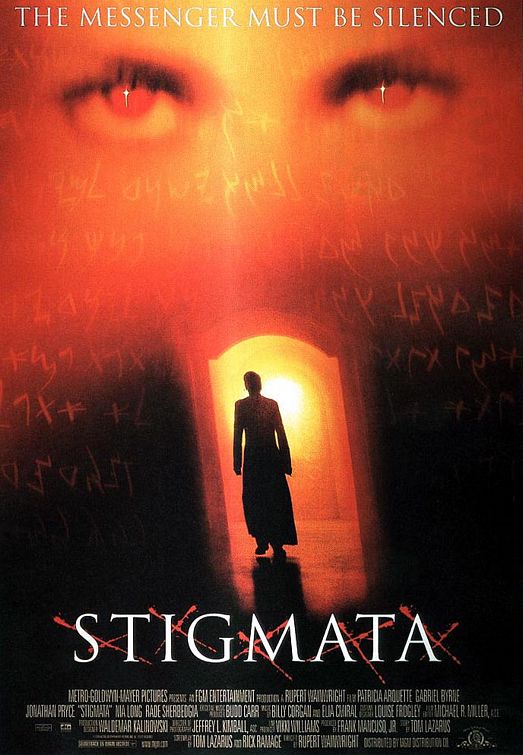
Supernatural Movie Reviews: Stigmata

So, I was torn between End of Days and Stigmata for this week, wanting to bang out another nineties non-classic before hitting up a current blockbuster next week. Ultimately, it was the latter’s availability as a Netflix streaming title that clinched it.

So let’s do this.


Stigmata

Year: 1999
Starring: Patricia Arquette, Gabriel Byrne
Directed by: Rupert Wainwright

Basic Plot:
Frankie (Arquette) is a care-free, worldly hairdresser (working at a tattoo/piercing parlor where you can almost see the hepatitis) whose life changes when she receives a gift from her mother in the mail—the crucifix of a priest who recently died in Brazil. She starts experiencing the stigmata (although she has no idea what it is). Enter Garbriel Byrne (who plays the devil in the other movie I was considering), an investigator sent by the Vatican to look into alleged miracles surrounding the priest’s death. He is intrigued, but must leave his work to investigate Frankie's alleged stigmata. Eventually, it becomes clear that Frankie is actually possessed by the dead priest (via his rosary?) and this all has something to do with the “Missing Jesus Gospel,” which the movie goes on to identify (in more than one way) as the Gnostic Gospel of Thomas.  Hijinx ensues.

Cast and Crew:
Okay, the writer of this thing hasn’t really written anything else of note. He did an episode of the short-lived Nightmare on Elm Street TV spinoff, “Freddy's Nightmares,” which I probably watched as an eleven-year-old through the fuzz on FOX 66, and then regretted it when I was too freaked out to sleep.

The director’s résumé is similarly spotty. Apart from directing Disney’s kid comedy Blank Check, he seems to have been mostly a music video director, including MC Hammer’s “2 Legit 2 Quit”  and some stuff by N.W.A.

The cast, on the other hand, is all-conference. I love Patricia Arquette (even though her acting is frequently panned). I love that she talks like a regular person and that she never got her janky teeth fixed. I love her work so much that I almost watched an episode of her show Medium once. But then I did something else instead. I’m also a big fan of Byrne, going back to the Usual Suspects.  The two leads share great chemistry on-screen.

In the background, it was nice to see Lindsey Bluth in a bit part. And...is that emergency room doctor Joan Cusack? Nope. It's Ann Cusack. Bet you didn't know there was an Ann Cusack. Well, there is. The corrupt milquetoast Cardinal is played by the now-easily-recognized milquetoast governor Weatherby Swann (of Pirates fame) and, if I had seen the new GI Joe reboot a couple years ago, I’d probably point out that he also played the milquetoast U.S. President in that.

Billy Corgan (who once penned the heartbreaking words, “And I still believe that I cannot be saved!” and who may or may not have become some strain of Christian in 2009) provides the Dust Brothers-esque score.  I think it’s pretty much awesome, although I remember IMDb as a whole condemning it when this movie first came out.

Merits and Demerits:
I honestly don’t mind formulaic movies, but come on . . .  Here’s the routine: candles blow themselves out (and re-light themselves), birds fly away loudly, stuff randomly starts on fire, the main character bleeds a bunch, people cross themselves. Repeat. Add demons. 

And again with the Virgin Mary statuette crying?! Really? Only this time it’s tears of blood, so it gets extra credit for lameness. Add to that a scene of a possessed girl levitating over her bed; nothing played out about that.

All the same, I find much to commend here, film-wise, and I realize that it’s probably because of my own foibles. First of all, unlike last week’s subject, Stigmata was filmed in California, but makes great use of establishing shots and well-designed, well-lit sets to convince us we’re in an extra-depressing version of Pittsburg. It’s very urban in a stylish way and this pleases me. I love this sort of post-Grunge thrift strore chic so prominent in this era of popular moviemaking.

The main character has the requisite black friend with purple hair who calls her “girlfriend.”  You have the arty shot from inside the microwave, (including a mug that says “cup”on it). In other words, this is the late-'90s, when music video directors still thought they could go big by channeling Tarantino through Fincher without irony and self-reference,  resulting in lots of cool shots of chipping paint, flickering flourescent lights, rain running down windows, grimy coffee shops, and desaturated colors (a la like Fight Club and Se7en). Honestly, watching this made me miss the '90s a little bit.

This premature nostalgia for my college years is magnified by the presence of old school scanners, 3.5" disks, and giant laptops. Oh, and DOS (DOS!) is central to a very tense scene involving evil Vatican officials and anachronistiaclly monochrome screens.

But the story. Ugh.

Theological Lowpoints:
Where to begin? How about with the name? For a movie called Stigmata, there’s a real lack of understanding about what the stigmata are. Granted, I’m a Protestant minister, so I don’t put great stock in this phenomenon anyway, but even I know that the back of Frankie’s shirt being ripped up will she is “scourged” by an invisible whip is a ridiculously ill-informed portrayal.  I know wikipedia didn't exist in 1999, but this kind of research would take mere minutes.

And then, how about the complete misunderstanding of what possession is?  I guess in Hollywood, where good people turn into angels when they die, it’s not too big of a stretch to have someone possessed by the spirit of a dead man, but from a biblical perspective, it’s beyond absurd. And really, I can’t figure out if the dead priest was actual “a holy man, very holy man,” as one character tells us or not. If so, why does he say all that filthy, somewhat blasphemous stuff that he does (through Frankie) and beat the crap out of one of his colleagues repeatedly (again, through Frankie)? It seems like they didn't really think this through . . .

And when I try to (think it through, that is), here’s what I come up with: the tears of the statue really are the blood of Christ. Why? Well, God is extra upset about . . . something. So much so, that he singles out the poor lady who has this dead priest's crucifix and starts torturing her with horrible violence and visions of freaky stuff like women dropping their babies into traffic. But, then again, maybe that’s just a result of being possessed by the spirit of a nice old priest who who has turned into a demonic figure. Other side effects include: automatic writing, your eyes turning different colors (like Teen Wolf), and receiving the stigmata, which (according to the movie) is usually reserved for the very pious. And all of this is happening in order to somehow get the word out that the Gospel of Thomas exists—a fact which is already common knowledge in our world.

But this movie clearly takes place in an alternate reality, one where an experienced and educated priest can be shocked by the news that there are (gasp!THIRTY-FIVE Gospels?! And a Vatican linguist can respond (with a straight face) that this is to be expected because “everyone had a different experience of Jesus. All the Gospels are just interpretations, memories, dreams, reflections.” Yes, this makes him sound like a college sophomore, but the guy says it with an accent, so we’re supposed to buy it, along with Gabe’s expositional response: “And there’s no one Gospel in Jesus’ actual words?” No, there’s not, says Fr. Accent.  “We’re all blind men in a cave, looking for a candle that was lit 2,000 years ago.”

And herein lies the real theological lowpoint. You see, I pastor a week of Christian summer camp (7th and 8th graders) each summer.  And the summer after Stigmata came out, at least five kids asked me about the Jesus Gospel spoken of in Stigmata.  (Who the heck would let their twelve-year-old watch this movie?)  I actually did a full-on exposé/talk on the subject, correcting the tapestry of factual errors presented in this flick, starting with the errors about this particular document.

In addition to the direct quotes included in the movie, the 'Dude, this stuff is real' text at the end of the film confirms that the writer was thinking of the Gospel of Thomas all along. But there’s no reason in the world to think that the Gospel of Thomas was written in Aramaic or that it predated the canonical Gospels. Or that it is the “actual words of Jesus.” That's just a claim of convenience, forgivable as a plot contrivance in a movie, but not when it's presented as fact and confusing my youth group kids and campers. The truth is readily discovered, as is the fact that the Vatican has done nothing to suppress the so-called “Gnostic Gospels.”

And, by the way, that’s Paleo-Hebrew you’re writing on the wall, not “Aramaic from the time of Jesus.” (Ironically, by the time of Jesus, Jews in Palestine were writing Hebrew with an Aramaic script, not the other way around..)

Beyond that whole mess, there’s the perpetually adolescent vibe that permeates the film, reminding me of those QUESTION AUTHORITY bumper stickers that were everywhere (including my bumper) fifteen years ago. Let’s review: the one good church in this story is rogue, connected to no institutional body. The good priest has been defrocked and excommunicated.  The other good priest is jaded and hates the hierarchy and the very idea of the church. The real climax for his character is when he finally throws his superior across the room and then sheds his clericals for some sweet stone-washed jeans.

We might sum up the movie’s message with a line from another excommunicated priest (played by Boris The Bullet Dodger): “I love Jesus! I don’t need an institution between him and me! No priests! No churches!” He then launches into a quote the Gospel of Thomas: “The Kingdom of God is inside you and all around you, not in mansions of wood and  stone. Split a piece of wood and I am there, lift a stone and you will find me.” This is in contrast to the Cardinal, who reminds Byrne’s character that “the cornerstone of our faith is the Church, not a crying statue.” Paging Dr. Strawman! Can I maybe get a third perspective? One that holds to Christ as the cornerstone of my faith, while also acknowledging that he established for himself a Church?

Theological Highpoints:
There aren’t many to speak of. The struggle of Gabriel Byrne’s character could have been one. He’s a scientist-turned-priest and never sure which identity is really him. The look on his face while he says, “This is the blood of Christ” while administering communion (to whom, I’m not sure) sets up a theological tension that is never explored, just lazily redacted.

There is some value in seeing modern doctors and nurses dealing with the wounds that accompanied Jesus’ crucifixion (one at a time and then all at once), reminding the viewer of how horrifying a death Jesus chose to endure on our behalf.

And, while I hate the use of the crucifix as a kitschy image like a skull and crossbones or that stupid Rolling Stones tongue thing, when they intercut it with shots establishing Frankie’s carnal lifestyle we are reminded again of the reason for the cross. Some of these raw materials here could have been used for a powerful story that rings true. Unfortunately, they weren’t.

Best Scares:
  • The reflection of the old priest in the mirror in a photograph of Frankie.
  • It’s wicked-creepy the first time she speaks with a man’s voice, rolls her eyes back in her head, and “becomes” the old priest, shuffling along in her retro elevator sandles. Patricia Arquette is way underrated.
  • Even though you know it’s coming, I jumped when she shouted, “ANSWER ME!” and then beat the tar out of poor Gabe. 

Most Memorable Lines:
  • “Am I going crazy or is Frankie hitting on a priest?” Why yes, she is. And it actually helps with character development. The relationship between Frankie and Father I-forget is the only believable thing in this contrived story.
  • “You know what's scarier than not believing in God? Believing in him...if it isn't God doing this to me, then who is?”
  • “Those words weren’t nonsenese. It’s actually a very specific language—a form of Aramaic that hasn't been used in 1900 years.” A very specific language, eh? As opposed to a non-specific language?
  • “Jesus said, Split a piece of wood and I am there. Lift a stone and you will find me.” Oh, just shut up, Fake Gnostic Jesus. You're boring. And you’re not nearly as deep as you think you are.


BTW, if you have a preference for next week, let me know. I'm thinking Insidious or Possessed.